
NRNB and Extra Places: How to Stack Bookmaker Offers for Maximum Protection
 Available in US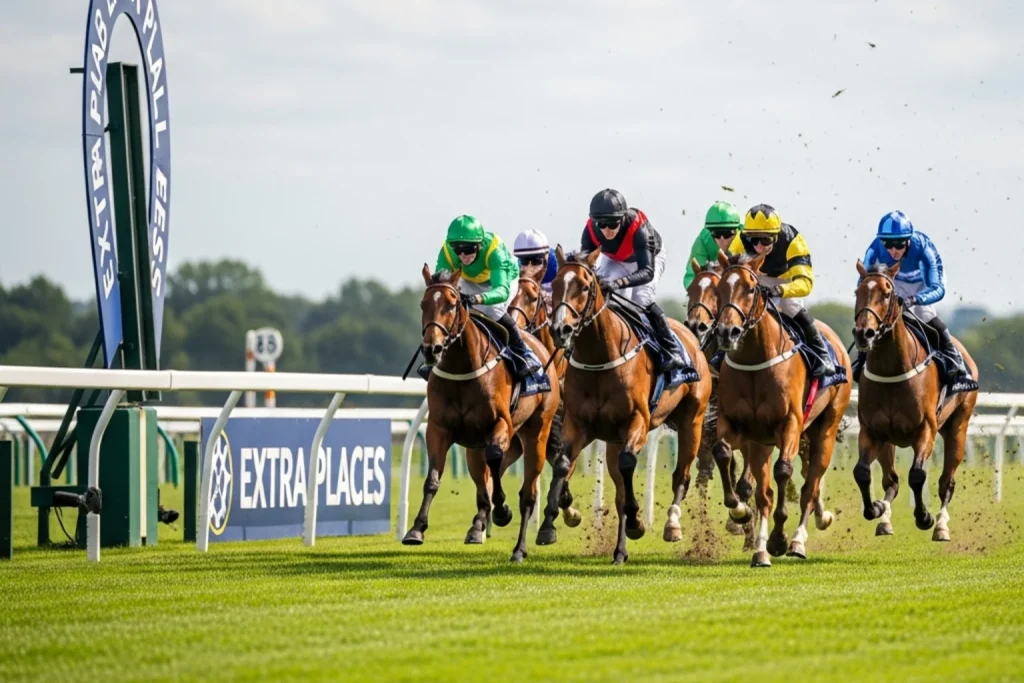
NRNB protects your stake if your horse doesn’t run. Extra places extend the number of finishing positions that count as a “place” in each-way betting. Used separately, each offer addresses a different risk. Used together, they create a layered defence that covers two of the most common ways an each-way bet can go wrong: the horse being withdrawn, and the horse finishing just outside the standard place terms.
Stacking bookmaker offers is not a loophole or a sharp practice — it is simply the application of multiple promotions to the same bet where the bookmaker’s terms allow it. Not all operators permit stacking, and those that do may impose conditions that limit the combined benefit. But where stacking is available, it represents genuine additional value that most punters leave on the table.
Layer your safety net. Here is how NRNB and extra places work in combination, and which bookmakers make it possible.
What Stacking Offers Means and Why It Matters
Stacking means applying two or more promotional offers to a single bet. In the context of horse racing, the most common stack involves NRNB (non-runner protection), BOG (best odds guaranteed), and extra places (enhanced place terms). Each offer covers a different dimension of risk, and when all three apply to the same bet, the punter’s downside is significantly reduced.
The average betting turnover per race in UK horse racing declined by 8% in 2026/25 compared to the previous year, according to the HBLB Annual Report. In a market where each pound staked represents a larger share of the total, maximising the protection on that pound is rational behaviour. Stacking offers is the mechanism through which bettors extract the most value from a declining promotional landscape.
The reason stacking is not universally available is cost. Each promotion has a cost to the bookmaker: NRNB costs the refund on withdrawn horses; BOG costs the difference between fixed price and SP; extra places cost the additional payouts on positions that would not normally be paid. When all three apply to the same bet, the combined cost to the operator increases, and some bookmakers manage this by preventing certain combinations or by capping the number of promotions that can apply simultaneously.
The result is a market where stacking availability varies by operator, by festival, and sometimes by individual race. Checking whether your intended stack is permitted is not optional — placing an each-way bet under the assumption that NRNB, BOG, and extra places all apply, when only two of the three are active, means you are carrying a risk you didn’t account for.
NRNB + Extra Places: How the Combination Works
Extra places extend the standard place terms for a specific race. If the standard terms pay three places (first, second, third), an extra-places promotion might pay four or even five. This is valuable in large-field handicaps where your horse is competitive but unlikely to win — the extra places increase the number of finishing positions that produce a return on the place half of your each-way bet.
When combined with NRNB, the two promotions cover complementary risks. NRNB protects your entire stake (win and place) if the horse is withdrawn. Extra places protect the place portion of your bet if the horse runs but finishes just outside the standard terms. Together, they address the two most common failure modes for each-way bets: the horse doesn’t run (NRNB) and the horse runs but doesn’t finish high enough (extra places).
Nevin Truesdale, Chief Executive of the Jockey Club, noted that the impact of affordability checks on racing’s financial ecosystem has been colossal, affecting jobs across stables, the breeding industry, and all supporting sectors. That broader economic pressure is relevant here because the promotional landscape — including stacking — is shaped by the same financial forces. Bookmakers offer extra places and NRNB to attract volume in a declining market, but the margin pressure created by affordability checks constrains how generous those offers can be.
The interaction between NRNB and extra places becomes particularly interesting when non-runners reduce the field size. Extra places are typically offered on races with a minimum number of runners. If non-runners bring the field below the threshold (say, from 16 runners to 14 in a race where extra places were offered for 16+), the bookmaker may withdraw the extra-places promotion. Your NRNB still applies — if your horse is one of the withdrawn — but the extra places that made the each-way bet attractive may no longer exist for the remaining runners.
This scenario is uncommon but not hypothetical. Festival handicaps with large entries are the races most likely to attract both NRNB and extra-places promotions, and they are also the races most vulnerable to multiple late withdrawals that reduce the field. Checking the bookmaker’s terms on whether extra places survive a reduction in field size is the specific piece of due diligence that separates informed stacking from wishful thinking.
Which Bookmakers Allow Offer Stacking in 2026
The major UK bookmakers take different approaches to stacking. bet365 generally permits NRNB and extra places to apply to the same bet on qualifying races, with BOG also active on most UK and Irish racing. The three-way stack — NRNB + extra places + BOG — is achievable at bet365 on many festival races, making it one of the most stacking-friendly operators in the market.
Paddy Power and Ladbrokes (both part of larger groups) also permit stacking on selected promotions, though the terms vary by festival and race. Paddy Power’s extra-places offers tend to be race-specific, announced individually, and the compatibility with NRNB is stated in the promotional terms for each event. Ladbrokes follows a similar model.
Sky Bet has been competitive on extra places in recent years and generally allows stacking with NRNB where both promotions are active. Coral, Betfair Sportsbook, and William Hill each have their own stacking policies, which can change between promotional cycles. The common thread is that no bookmaker has a single, permanent stacking policy — the terms are set per promotion, and the only way to confirm compatibility is to read the terms on the day.
The levy collected from bookmakers hit a record of nearly £109 million in 2026/25, reflecting a market where operators are generating strong margins even on lower volumes. That margin environment supports promotional activity, but it also means bookmakers are monitoring the cost of stacked promotions more closely than they would in a high-volume market. The promotional generosity that makes stacking possible is a product of competitive pressure, and it could tighten if margins come under further strain.
Layer your safety net. NRNB and extra places are not the same offer, do not cover the same risk, and are most powerful when applied together. The bookmakers that permit stacking are competing for your business, and the promotions they offer are designed to attract bets they would not otherwise receive. Using them in combination is not gaming the system — it is using the system exactly as the bookmakers intended when they built the promotions. The only requirement is that you verify the stack is live before you place the bet, not after.
NRNB and Extra Places — More on this topic at non runner no bet.
See also Non-Runner Trainer Patterns.
