
Non-Runner Each-Way Bets: How Both Parts of Your Stake Are Affected
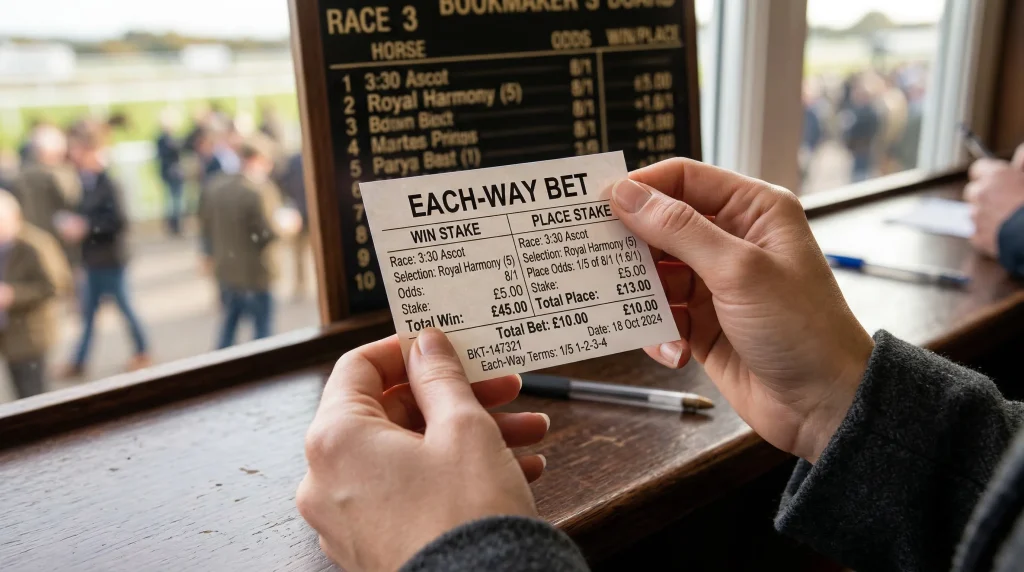
A non-runner each-way bet creates a situation that confuses even experienced punters: your horse is withdrawn, but your bet has two separate components, each with its own settlement logic. The win part and the place part are not treated as a single wager. They are processed independently, and understanding this distinction is essential if you want to know what you’re owed — or what you’ve lost.
Each-way betting splits your total stake in half. One half goes on the horse to win; the other half goes on the horse to finish in a paying place position, typically at a fraction of the win odds (1/4 or 1/5, depending on the race). When a non-runner enters the picture, both halves are affected — but not always in the same way, and not always by the same amount.
This matters more than it might seem. In May 2026, the BHA expanded the circumstances under which a horse can be declared a non-runner from the starting stalls, giving stewards new powers to void runners that fail to leave the gate. That rule change widened the window in which your each-way bet can be disrupted, and it applies to both parts of the stake.
How the Win Part and Place Part Are Processed Separately
When your each-way selection is declared a non-runner, both halves of your stake are returned. This is the same principle that applies to any single bet: your horse didn’t run, so the bet is void. If you staked £10 each way (£20 total), you get £20 back. No deductions, no complications.
The more interesting scenario — and the one that catches people out — is when a different horse in the same race is withdrawn. Your selection still runs. Your bet is still live. But the non-runner triggers Rule 4 deductions that apply to your payout if you win, and these deductions hit the win part and the place part separately.
Here is how it works in practice. The win portion of your each-way bet is subject to the Rule 4 deduction scale based on the withdrawn horse’s starting price. If the non-runner was a 3/1 shot, the deduction might be 25p in the pound. That deduction is applied to the profit element of your win return. Separately, the place portion is also subject to a Rule 4 deduction — but it is calculated on the place odds, which are a fraction of the win odds.
The two parts are settled independently. You might receive a reduced win return and a reduced place return, or you might receive nothing on the win side (if your horse finishes second) but a reduced place return. The deductions apply in parallel, not sequentially.
Where punters go wrong is in assuming that a single Rule 4 figure covers both parts of the bet. It doesn’t. The deduction percentage is the same — 25p in the pound is 25p in the pound whether applied to the win or the place — but the base amounts are different because the place odds are lower. The net effect is that the place return shrinks proportionally less in absolute terms, even though the percentage reduction is identical.
If NRNB applies (because you placed the bet under a non-runner-no-bet promotion), and your selection is the one withdrawn, the full each-way stake is returned — both halves. The refund may come as cash or as a free bet depending on the bookmaker’s terms. But NRNB does not shield you from Rule 4 deductions caused by other horses being withdrawn. Those deductions still apply in full.
Rule 4 Applied to Each-Way: Worked Example
Let’s put numbers to this. You place £10 each way on Horse A at 8/1 in a handicap. The place terms are 1/4 odds, so your place bet is effectively at 2/1. Your total outlay is £20.
Before the race, Horse B (priced at 4/1) is declared a non-runner. The Rule 4 deduction for a 4/1 withdrawal is 20p in the pound.
Horse A wins. Without any deduction, your returns would be: win part = £10 stake + £80 profit = £90; place part = £10 stake + £20 profit = £30. Total: £120.
With the Rule 4 applied, the deduction takes 20% off the profit element of each part. Win profit: £80 minus 20% = £64. Place profit: £20 minus 20% = £16. Your adjusted returns are: win = £10 + £64 = £74; place = £10 + £16 = £26. Total: £100. You have lost £20 to the deduction — roughly 17% of the original return — because another horse didn’t show up.
Now consider the case where Horse A finishes third, in the places but not winning. The win part of the bet loses entirely. The place part pays: £10 stake + £16 (after Rule 4 deduction) = £26. From a £20 total outlay, that’s a modest profit, but it’s less than the £30 you would have received without the non-runner adjusting your payout.
If two horses are withdrawn from the same race, Rule 4 deductions are cumulative. If Horse B triggers a 20p deduction and Horse C triggers a 15p deduction, the combined deduction is 35p in the pound. The same calculation is applied separately to both the win profit and the place profit.
These examples use clean numbers for clarity. In practice, the deduction scale is fixed by Tattersalls Rule 4(c) and ranges from 5p to 90p in the pound, depending on the withdrawn horse’s odds. The lower the price of the non-runner, the higher the deduction — which means a favourite being withdrawn hurts every remaining bettor’s payout the most.
When Non-Runners Reduce Place Terms
There is a second, often overlooked consequence of non-runners for each-way bettors: the place terms themselves can change. When enough horses are withdrawn from a race, the number of runners drops, and bookmakers adjust the number of paying places accordingly.
The standard place terms in UK horse racing depend on the size of the field. Races with five to seven runners typically pay two places. Eight or more runners pay three places. In handicaps with sixteen or more runners, four places are paid. Drop below five runners and most bookmakers void the place part entirely — your each-way bet becomes a win-only single at the original odds.
This is where non-runners can hurt twice. Suppose you back a horse each way in a twelve-runner handicap at 1/4 odds for three places. Two horses are withdrawn, bringing the field to ten. The place terms remain unchanged — still three places at 1/4 odds. But if four are withdrawn, leaving eight runners, you’re still in three-place territory. Drop to seven, however, and you fall to two paying places. Your horse needed to finish in the first three; now it needs to finish in the first two.
BHA data from February 2026 showed that 52% of races on Premier Jump fixtures had eight or more runners, according to the BHA Racing Report. That means roughly half the Jump card sits near the threshold where a couple of withdrawals can shift the place terms. On smaller cards — midweek fixtures, all-weather meetings — the margins are even tighter.
The worst-case scenario for an each-way bettor is a race that starts with exactly five runners after withdrawals. At five, most bookmakers still pay two places, but the place fraction may drop from 1/4 to 1/5 at some operators. Below five, the place part is typically void. If the field was announced at six and one horse withdraws on the morning of the race, you have gone from a comfortable each-way proposition to a marginal one — and you had no control over it.
Some bookmakers offer “extra places” promotions on specific races, particularly during festivals. These extend the standard place terms by one or two positions, which provides a buffer against non-runner erosion. Combining an extra-places offer with NRNB protection (where available) is one of the few ways to insulate an each-way bet from both types of non-runner risk: the direct withdrawal of your horse and the indirect reduction in field size.
Two stakes, two outcomes. That is the fundamental reality of each-way betting when non-runners are involved. The win part and the place part live separate lives, absorb separate deductions, and can produce very different results from the same race. Knowing how the mechanics work won’t prevent withdrawals, but it will prevent that particular brand of confusion that comes from staring at a betslip and wondering where the rest of your return went.