
Non-Runner Lucky 15 Rules: How Withdrawals Affect Your Combination Bet
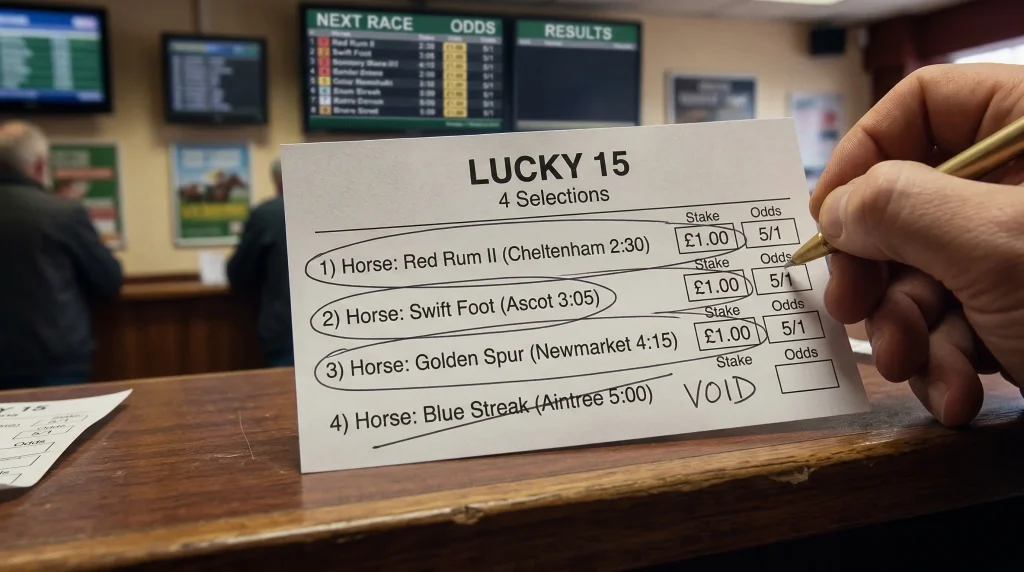
A non-runner in a Lucky 15 doesn’t kill the bet — but it reshapes it in ways that aren’t always obvious. Lucky 15s, Lucky 31s, and Lucky 63s are full-cover combination bets, meaning they contain every possible singles, doubles, trebles, and accumulators from your selections. When one leg is voided, the remaining structure still holds. But the number of surviving bets drops, the potential payout contracts, and certain bonus conditions may shift.
These bets are popular precisely because they offer coverage. You don’t need all four (or five, or six) horses to win for a return. A single winner can pay out. That resilience is what makes combination bets attractive to punters who want the upside of a multiple without the all-or-nothing fragility of a straight accumulator. The question is: does a non-runner erode that resilience, or does the structure absorb it?
The answer depends on which bets survive, how many vanish, and whether your bookmaker’s bonus terms still apply to the reduced slip. Although the BHA reports that withdrawal rates have dropped to levels not seen since 2022, even a single scratching on a four-selection Lucky 15 wipes out more bets than most punters realise.
How a Lucky 15 Breaks Down — and What Happens When One Leg Goes
A Lucky 15 consists of 15 bets across four selections: 4 singles, 6 doubles, 4 trebles, and 1 four-fold accumulator. At a £1 unit stake, you are placing £15 in total. Every combination of your four horses is covered, which means any single winner guarantees at least one payout.
When one of those four selections is declared a non-runner, the voided horse is removed from every bet it appears in. The maths is straightforward but the impact is significant. The voided horse features in: 1 single, 3 doubles, 3 trebles, and 1 four-fold. That’s 8 bets out of 15. Those 8 bets are void — your stakes on them are returned, but they no longer contribute to your potential returns.
What remains is effectively a Lucky 7 (technically a Patent) on three selections: 3 singles, 3 doubles, and 1 treble. Your active stake has dropped from £15 to £7. The structure still functions — any single winner among the remaining three pays out — but the four-fold accumulator is gone entirely, and so is the largest potential payout on the slip.
Shaun Parker, the BHA’s Head of Stewarding, noted when the non-runner rule was extended to Jump races in October 2026 that the expanded stalls rule had been applied roughly half a dozen times since its introduction. Each of those instances would have triggered exactly this kind of recalculation for any Lucky 15 that included the affected horse.
If two selections are voided, the damage compounds. You lose both their singles, all doubles and trebles that included either of them, and the four-fold. From 15 bets, you’re down to just 3: two singles and one double on the surviving pair. From £15 staked, only £3 is still active. You need both remaining horses to win for the double to pay, or either to win for a single return. The safety net that made the Lucky 15 appealing has become very thin.
The refunded stakes from void bets are returned at settlement. Most bookmakers process this automatically — you’ll see the void bets listed separately on your settled slip, each showing a zero profit/loss and the stake returned. There is no Rule 4 deduction on void legs, because those bets never ran. Rule 4 only applies to bets that remain live, where a different horse in the same race is withdrawn.
Lucky 31 and Lucky 63: The Same Logic, Higher Stakes
A Lucky 31 covers five selections across 31 bets: 5 singles, 10 doubles, 10 trebles, 5 four-folds, and 1 five-fold. A Lucky 63 covers six selections across 63 bets with the same full-cover logic extended by one more layer. The non-runner mechanics are identical to the Lucky 15 — void the horse, remove every bet that includes it, refund those stakes, settle the rest.
The numbers scale predictably. In a Lucky 31, one non-runner voids 16 of the 31 bets: 1 single, 4 doubles, 6 trebles, 4 four-folds, and the five-fold. You’re left with 15 active bets — which happens to be exactly a Lucky 15 on the surviving four selections. From a £31 stake, £16 is returned and £15 remains in play.
In a Lucky 63, one non-runner voids 32 of the 63 bets. You’re left with 31 bets — a Lucky 31 on five selections. From £63 staked, £32 comes back and £31 stays active. The pattern is clean: losing one leg from a Lucky 63 gives you a Lucky 31; losing one from a Lucky 31 gives you a Lucky 15; losing one from a Lucky 15 gives you a Patent.
The practical consequence is that larger combination bets are more resilient to a single non-runner in percentage terms. Losing one leg from a Lucky 63 voids about 51% of bets. Losing one from a Lucky 15 voids 53%. The proportional damage is similar, but the absolute number of surviving bets in a Lucky 63 (31) still provides substantial coverage across the remaining selections.
Two non-runners in a Lucky 63, however, reduce it to a Lucky 15 on four selections. Three non-runners leave you with a Patent on three. At that point, the bet has lost most of its structural advantage, and the refunded stakes represent the majority of your original outlay. Whether this is a disaster or merely an inconvenience depends on how your surviving selections perform — but the safety margin that justified the higher total stake has largely evaporated.
Do Consolation Bonuses Still Apply After a Non-Runner?
Most major UK bookmakers offer consolation bonuses on Lucky 15, Lucky 31, and Lucky 63 bets. The typical structure: if only one of your selections wins, the single is paid at enhanced odds — often double the SP or a percentage uplift. Some operators also offer a consolation if all selections lose, returning a portion of the stake as a free bet. These bonuses are a significant part of the Lucky 15’s appeal, and the question of whether they survive a non-runner is one punters ask frequently.
The answer varies by bookmaker, and this is one area where reading the terms is genuinely important. The general principle is that consolation bonuses apply to the adjusted bet — meaning the structure that remains after void legs have been removed. If your Lucky 15 becomes a Patent (three selections after one non-runner), the consolation bonus is assessed against that Patent, not the original Lucky 15.
In practice, this means: if you had four selections, one is voided, and exactly one of the remaining three wins, some bookmakers will still apply the single-winner bonus because you had only one winner from your active selections. Others restrict the bonus to the original bet type — if the terms say “Lucky 15 single-winner bonus” and your bet has been reduced to a Patent, the bonus may not apply. The distinction is operator-specific and often buried several paragraphs into the promotional terms.
The all-losers consolation is clearer. If all your active selections lose (after void legs are excluded), most bookmakers treat this as qualifying for the consolation. You won’t receive a consolation on the void legs themselves — those were refunded — but the losing active legs may trigger the safety net. Again, terms differ: some operators require all original selections to have run for the all-losers bonus to activate.
With overall betting turnover on British racing having fallen by 6.8% in 2026, according to the BHA Racing Report, bookmakers have been adjusting promotional terms more frequently. Consolation bonus structures that were standard two years ago may have been tightened or amended. Checking the specific terms on the day you place the bet — not relying on what applied last season — is the only reliable approach.
Fewer legs, still in the game. That’s the core advantage of full-cover bets, and it holds even after a non-runner thins the structure. The bet shrinks, the refunded stakes come back, and the surviving combinations are settled on their own merits. What changes is the ceiling — the maximum payout drops significantly, and the bonus terms may or may not follow. Knowing exactly how many bets survive, and on what terms, is the difference between a bet you understand and one that surprises you at settlement.