Non-Runner No Bet at William Hill: Terms, Festival Coverage, and How It Compares
Non runner no bet at William Hill carries the weight of one of the oldest names in British bookmaking, but heritage does not guarantee the most competitive NRNB terms. William Hill, now part of the 888 Group following its acquisition, offers NRNB as a promotional feature across selected horse racing meetings. The scope, the refund type, and the qualifying conditions have all shifted since the ownership change, and what William Hill offered three years ago is not necessarily what it offers today.
For punters evaluating where to place ante-post bets, William Hill’s NRNB needs to be assessed on its current terms, not its historical reputation. The UK horse racing betting market generated gross gaming yields of £766.7 million in the year to March 2026, according to the Gambling Commission, making it the second-largest sport for remote betting after football. In a market that size, the differences between NRNB offers are not marginal — they represent real money returned or retained on every withdrawn horse.
William Hill’s NRNB — terms decoded — starts with understanding what the operator covers, what it excludes, and where it sits relative to the competition.
William Hill NRNB Terms: What the Offer Actually Covers
William Hill’s NRNB promotion follows the standard industry format: it applies to win singles placed at fixed odds on qualifying races during a specified promotional window. The purpose is to protect ante-post bettors whose selection is withdrawn before race day — returning the stake rather than settling the bet as a loser under standard ante-post rules.
The refund type at William Hill has historically been a mix of cash and free bet returns, depending on the specific promotion. Some festival NRNB offers have refunded in cash; others have used free bets with wagering conditions. The trend across the industry has been toward cash refunds — punters prefer them, and operators competing for ante-post volume have found that cash-back offers generate higher bet volumes than free-bet equivalents. Whether William Hill aligns with this trend for any given festival is determined by the promotional terms published before the event.
Qualifying criteria typically include minimum odds (often 1/5 or longer), restriction to win singles (excluding each-way and multiples), and placement within the promotional window. The promotional window usually opens several weeks before a major festival and closes at the off of the first qualifying race. Bets placed outside this window — either too early or too late — do not qualify.
One aspect of William Hill’s terms that merits attention is the treatment of price changes. If you place an ante-post bet at 10/1 and the horse drifts to 20/1 before being withdrawn, the NRNB refund is based on your original stake, not the revised market position. This is standard across the industry, but it underscores the point that NRNB protects your stake, not your market position. You get back what you put in, regardless of how the market moved after your bet was placed.
William Hill’s general promotional terms apply on top of the NRNB-specific terms. These include the operator’s right to limit or exclude customers from promotional offers, which is a standard clause in regulated betting but one that can affect regular bettors who have been flagged as bonus-seeking or arbitrage-focused. If you rely on NRNB as a core part of your betting strategy, being aware that access to the promotion is not guaranteed is prudent.
William Hill NRNB Across Major UK Festivals
William Hill has traditionally offered NRNB across the major UK festival calendar: Cheltenham, Aintree (Grand National), and Royal Ascot. The depth of coverage has varied. In peak years, the offer extended to all races on all days of each festival. In leaner promotional cycles — particularly during and after the ownership transition to 888 Group — the offer has sometimes been limited to feature races or selected days.
Cheltenham attendance fell to 218,839 in 2026, the lowest figure in a decade. But lower attendance has not translated to lower betting volumes on the festival — the ante-post market for Cheltenham remains one of the largest in UK racing, and bookmaker NRNB offers are a significant driver of that early betting activity. William Hill’s Cheltenham NRNB, when offered, typically covers all 28 races across the four days and opens several weeks before the meeting.
The Grand National NRNB at William Hill usually focuses on the main Aintree race and may extend to the full three-day meeting. Given the Grand National’s unique entry structure — dozens of horses competing for a limited number of places — the ante-post non-runner rate is far higher than for any other UK race, making NRNB protection particularly valuable.
Royal Ascot receives variable treatment. The Flat racing calendar generates a different betting pattern from the National Hunt season: shorter ante-post windows, more predictable fields, and lower non-runner rates. William Hill’s NRNB for Ascot has been offered in recent years but is not always at the same level of coverage as the Jump season festivals.
Beyond the top three, William Hill may extend NRNB to events such as the Ebor at York, the King George at Kempton, and the November Meeting at Cheltenham. These are announced individually and should not be assumed unless explicitly promoted on the William Hill platform.
William Hill vs Competitors: Where NRNB Stands
When measured against the major competitors — bet365, Paddy Power, Sky Bet, Ladbrokes, and Coral — William Hill’s NRNB occupies the middle ground. It is neither the most aggressive (bet365’s consistent cash refunds and broad coverage set the benchmark) nor the most restrictive. The offer is credible, the terms are in line with industry norms, and the brand’s high street and online presence makes it accessible to a wide range of punters.
Where William Hill has historically lagged is in consistency. The operator’s NRNB terms have been more variable than those of bet365 or Paddy Power, partly due to the ownership changes and strategic reorientation under the 888 Group. Punters who used William Hill NRNB in 2022 should not assume the same terms apply in 2026 without verifying.
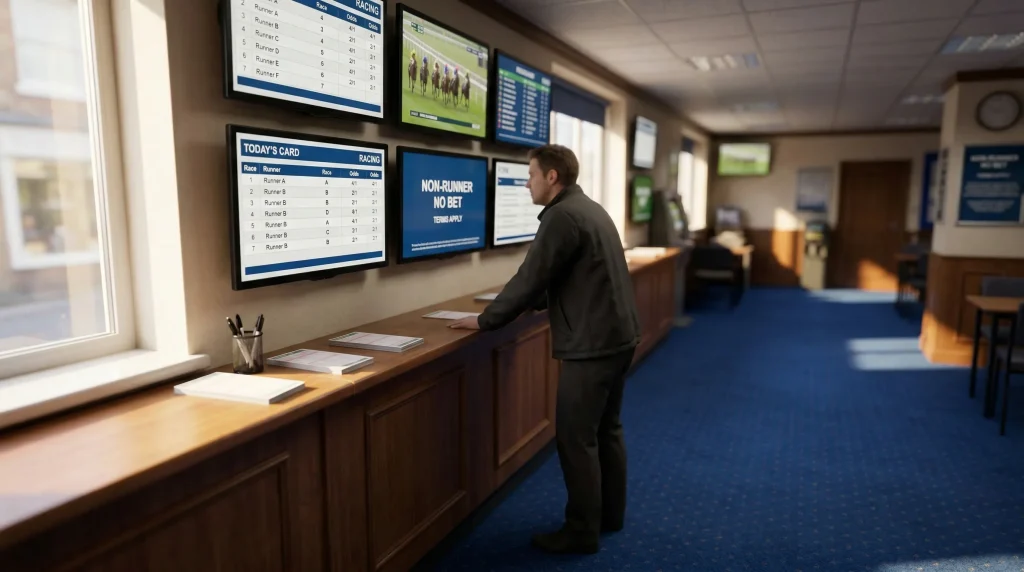
The areas where William Hill competes well include its retail-online integration. As one of the few major bookmakers with a significant high street presence, William Hill offers NRNB both online and in selected shops. For punters who prefer to place bets in person, this is a differentiator — most NRNB promotions from digital-first operators like Sky Bet or Betfair Sportsbook are online-only.
Best Odds Guaranteed, which ensures you receive the higher of your fixed price and the starting price, is another complementary offer that William Hill provides alongside NRNB on qualifying races. The combination of BOG and NRNB means your price is protected upward (BOG) and your stake is protected against withdrawal (NRNB). Not all competitors stack both offers on the same races, so checking whether William Hill applies both to a given festival is worth the effort.
William Hill’s NRNB — terms decoded — reveals a solid, if sometimes variable, offering. The brand’s heritage and reach make it a natural choice for many UK punters, and the NRNB promotion covers the festivals that matter most. But the terms are the terms, and they need to be checked each season. In a market where NRNB is a competitive differentiator, William Hill’s offer is worth evaluating alongside, not instead of, what the competition provides.