
UK Horse Racing Betting Market 2026: Turnover, Trends, and What the Numbers Mean for Bettors
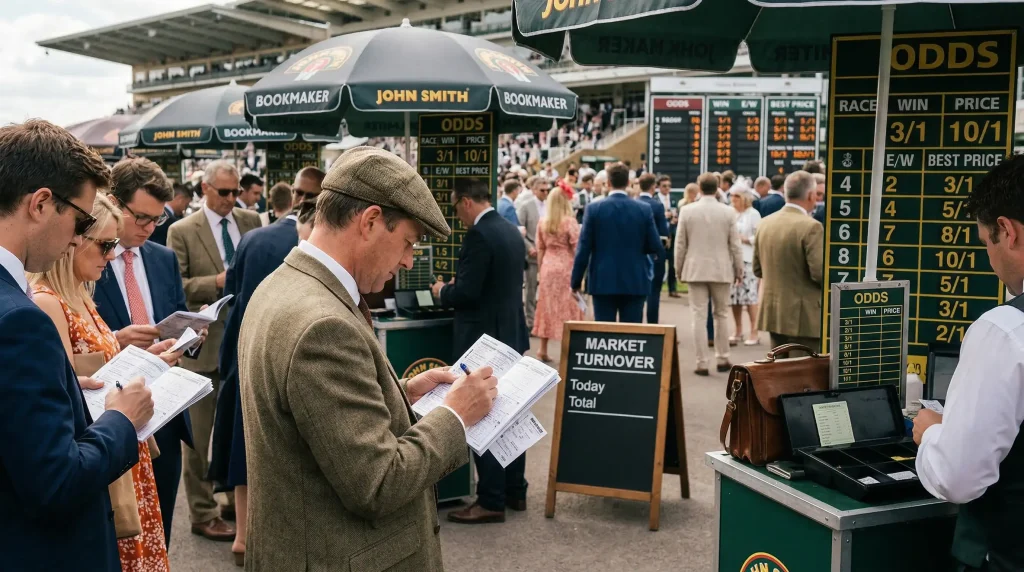
The UK horse racing betting market in 2026 is defined by a paradox: the industry generates hundreds of millions in revenue, yet the underlying volumes are shrinking. Turnover is falling, participation is concentrated into a handful of festival weeks, and the regulatory landscape is reshaping how bookmakers compete for customers. For bettors, these macro trends are not abstract — they directly influence the availability and quality of promotions like NRNB, the competitiveness of odds, and the long-term health of the sport they bet on.
Understanding the numbers behind the betting ring is not a prerequisite for placing a winning bet. But it provides context that makes the rest of the market — the offers, the restrictions, the shifts in bookmaker strategy — make sense.
GGY and Turnover: The Core Metrics for UK Racing Bets
Gross gaming yield — GGY — is the headline measure of the UK betting market. It represents the total amount retained by operators after paying out winnings: the industry’s gross revenue from betting activity. For the financial year April 2026 to March 2026, GGY from remote horse racing betting in the UK stood at £766.7 million, according to the Gambling Commission’s annual report. That figure makes horse racing the second-largest sport for online betting in Britain, behind football’s £1.3 billion.
The year-on-year comparison tells a more nuanced story. In the previous financial year (April 2023 to March 2026), remote horse racing GGY was £771.1 million. The decline of roughly £4.4 million — less than 1% — appears modest, but it follows a steeper trajectory in underlying turnover. GGY can remain stable or even rise while turnover drops, because GGY is a function of both volume and margin. If bookmakers retain a larger percentage of a smaller total staked, GGY holds steady even as the market contracts.
Turnover tells the unvarnished story. Total betting turnover on British racing fell by 6.8% in 2026 relative to 2023, and by 16.5% compared to 2022. The first quarter of 2026 showed a further 9% decline against the equivalent period in 2026. These are not blips. They represent a sustained, multi-year contraction in the amount of money being wagered on horse racing in the UK.
The per-race figures are even more telling. Average betting turnover per individual race declined by 8% in 2026/25 compared to the previous year, by 15% against 2022/23, and by 19% against 2021/22. The drop is sharper at the individual event level than the aggregate suggests, because the number of race fixtures has remained broadly stable — meaning each race is attracting less money, not that there are fewer races to bet on.
For bettors, the practical implication is this: the market you are betting into is smaller than it was three years ago. Smaller markets can mean thinner liquidity on exchanges, tighter promotional budgets at bookmakers, and — eventually — lower prize funds that reduce the quality of the racing product itself. The connection between turnover and the sport’s financial health is not hypothetical; it is the mechanism through which the betting market funds the racing it depends on.
Who Is Betting on Horses? Participation and Seasonal Patterns
The Gambling Commission’s participation surveys reveal a market that is heavily seasonal. In the wave covering April to July 2026, 7% of British adults reported having bet on horse racing in the previous four weeks. In the preceding wave — January to April 2026 — the figure was just 4%. That seasonal jump, driven almost entirely by Cheltenham, the Grand National, and Royal Ascot, illustrates how concentrated the market is around a small number of high-profile events.
The 7% figure is significant because it represents the peak: outside the spring-to-summer festival window, horse racing betting participation drops to levels that barely register alongside football’s year-round dominance. For bookmakers, this means the festivals are the critical window for customer acquisition. NRNB offers, BOG promotions, and enhanced odds are all concentrated in this period because the audience is largest and the return on promotional spending is highest.
The demographic profile of horse racing bettors has also shifted. The Gambling Commission data shows that the core audience skews older and more male than the general betting population, with a higher proportion of established, regular bettors rather than casual or first-time users. This has implications for promotional strategy: NRNB appeals most to punters who already understand ante-post risk and are specifically seeking protection against it, rather than to casual bettors who may not even realise the distinction between ante-post and day-of-race markets.
The seasonal concentration also means that the annual turnover figures are heavily influenced by a few weeks of racing. A good Cheltenham for bookmakers — where the favourites win and payouts are lower — can lift the year’s figures. A bad one, where outsiders dominate and NRNB refunds stack up, can drag them down. The 2026/25 levy record of nearly £109 million was partly attributed to Cheltenham results that favoured the bookmakers, illustrating how a single week in March can shape the industry’s annual financial report.
How Declining Turnover Is Shaping Bookmaker Promotions
The sustained turnover decline has forced bookmakers to recalibrate their promotional strategies. In a growing market, operators can afford to be generous with NRNB, BOG, and extra places because the expanding volume covers the cost. In a contracting market, every promotion is scrutinised more closely for its return on investment.
Richard Wayman, the BHA’s Director of Racing, stated that the decline in betting revenue is led by the impact of affordability checks, which are causing people either to stop betting altogether or to migrate to unlicensed operators. That analysis was supported by BHA data showing the turnover decline accelerating in the quarters following the implementation of enhanced financial checks by regulated operators.
The consequence for bettors is a tension between generosity and sustainability. Bookmakers want to offer NRNB to attract ante-post volume, but they also want to limit the cost of refunds in a market where margins are under pressure. The result is offers that are more precisely targeted: NRNB on specific festivals rather than year-round, on win singles rather than all bet types, and with terms that may include maximum stake limits or minimum odds thresholds.
This targeting is not inherently negative for punters. A well-defined NRNB promotion on Cheltenham, Aintree, and Ascot covers the races where protection is most valuable. But it does mean that the broad, open-ended NRNB offers that existed in the early 2020s are less common. The market is more competitive, the terms are more specific, and the punter who reads the fine print is the one who benefits most.
The numbers behind the betting ring paint a clear picture: a market that is significant in absolute terms, declining in trajectory, and increasingly concentrated around a small number of seasonal peaks. For bettors, the takeaway is that the promotions you see today — including NRNB — are products of this specific market environment. They exist because bookmakers are competing for a shrinking pool of active punters, and they will evolve as the market continues to shift. Understanding the macro context doesn’t change your next bet, but it does explain why the offer you’re betting under looks the way it does.